The Faculty of Natural Sciences and Mathematics (FCNM) at ESPOL continues to strengthen its role as a key contributor to the creation of spaces that connect scientific knowledge with the challenges faced by the productive and social sectors.
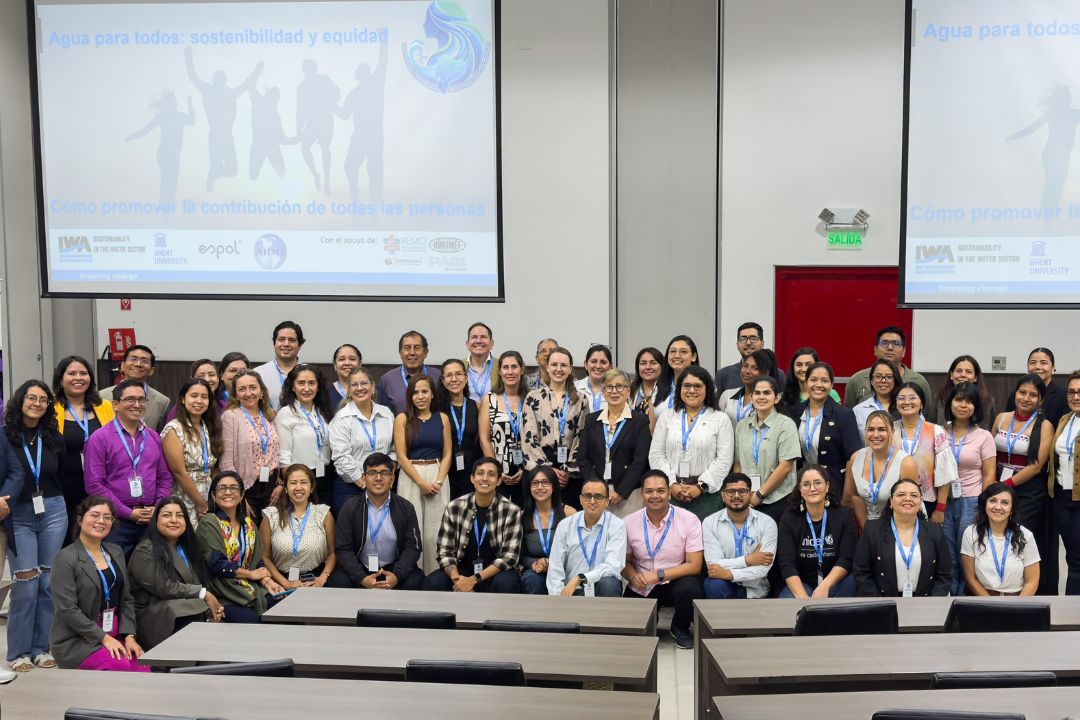
In this context, on January 12, FCNM hosted the workshop “Water for All: Sustainability and Equity,” an event designed to foster technical dialogue among academia, industry, and society. The initiative sought to highlight and address the gender equity challenges facing the water sector while promoting concrete actions toward its long-term sustainability.
According to Dr. Suanny Mosquera, event organizer and FCNM faculty member, initiatives of this kind are essential for encouraging interdisciplinary exchange aimed at developing sustainable, evidence-based solutions that integrate a gender equity perspective into water management.
“In this way, FCNM strengthens its role as a bridge between academia, the productive sector, and society, contributing to the education of professionals committed to sustainability and equity within the country's water sector,” she stated.
The event brought together more than 80 participants, who attended presentations and discussion sessions focused on the challenges faced by individuals and organizations in advancing gender equity within the water sector.
During the workshop, Dr. Andrée de Cock, author of the book Women in Water published by the International Water Association (IWA), presented the global project she leads. The initiative’s first phase identified and highlighted the main challenges faced by women working in the water sector. She also shared the objectives of the project’s second phase, which focuses on promoting concrete actions and solutions from both individuals and organizations, marking the launch of the workshop’s activities in Ecuador.
Dr. Suanny Mosquera also presented an overview of Ecuador’s current water-related challenges, addressing issues such as access to water, water quality, and the impacts of climate change. In her presentation, she emphasized the strategic role of women in water management and stewardship, underscoring the importance of incorporating gender equity as a cross-cutting principle in the pursuit of sustainable and resilient solutions for the water sector.
The workshop received the support and participation of national and international organizations, including the International Water Association (IWA), the Inter-American Association of Sanitary and Environmental Engineering (AIDIS), the Ecuadorian Network of Women Scientists (REMCI), PAM Saint-Gobain Sidertecnica, and CODEMET.
As part of the event’s practical component, representatives from the private sector participated in working groups alongside members of FCNM and IWA, fostering the co-creation of solutions aimed at achieving more inclusive and sustainable water management in the following areas:
- Career Opportunities and Professional Growth
- Disrespectful Behavior in the Workplace
- Self-Confidence
- The Impact of Age on Career Opportunities
- Work–Life Balance
- Mentorship and Professional Development
Helen Arteaga, representative of CODEMET, emphasized the importance of gender-focused initiatives promoted by academia, noting that they enable organizations to “bring men and women together and develop joint projects that contribute to improving water treatment,” thereby strengthening collaboration and fostering more inclusive solutions within the water sector.
Similarly, Engineer Martha Orta, representative of the Technical Division for Energy Transition and Decarbonization of AIDIS, highlighted the importance of creating spaces for dialogue and action-oriented reflection.
“Having this exchange of ideas and identifying those key actions needed to build a more equitable world is essential,” she stated, emphasizing the importance of strengthening the role of women in the sector and supporting them in addressing current challenges.
Through initiatives such as this workshop, FCNM reaffirms its institutional commitment to connecting academic knowledge, industry stakeholders, and strategic networks, contributing to sustainable development and the creation of solutions to the water-related challenges facing Ecuador.