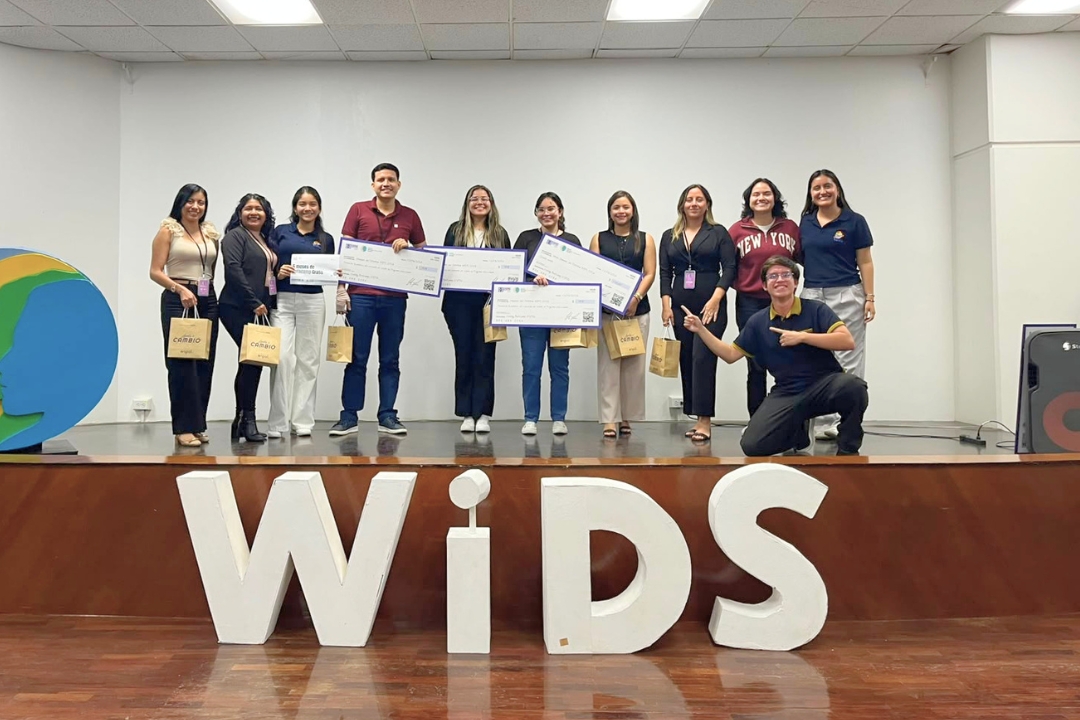


The BIN team, made up of Laura Apupalo, Geovanny Gutiérrez, Fabricio Quinto, and Britney Rodríguez, alumni of the Statistics Engineering program at ESPOL’s Faculty of Natural Sciences and Mathematics (FCNM), earned first place in the WiDS Datathon 2026, a data science competition held last June at Escuela Superior Politécnica del Litoral (ESPOL).
The initiative is part of Women in Data Science (WiDS), a global movement led by Stanford University that promotes the participation and leadership of women in data science and artificial intelligence.
WiDS Datathon 2026 initially attracted 400 participants from across Ecuador. The final round brought together nearly 100 competitors from universities such as Universidad Estatal de Milagro, Universidad de Especialidades Espíritu Santo (UEES), ECOTEC, Universidad Politécnica Salesiana, and Universidad Técnica de Manabí, among others, as well as professionals from organizations including the National Institute of Statistics and Census (INEC), Banco Guayaquil, and Banco Bolivariano.
Today, Laura and Geovanny work as professionals at the National Institute of Statistics and Census (INEC), while Fabricio is employed at Bosch and Britney Rodríguez works at Banco Guayaquil. Together, they formed the team that developed the winning solution in the Threat Time Prediction category. Their proposal used survival analysis models to estimate how long it would take a wildfire to reach an evacuation zone, incorporating variables related to terrain characteristics, weather conditions, and fire behavior to calculate the probability of impact across different time horizons.
The education they received through FCNM’s Statistics Engineering program, with its strong emphasis on data analysis, statistical modeling, and quantitative thinking applied to real-world problems, provided the technical foundation for a proposal that stood out for both its methodological rigor and practical applicability. The judging panel also recognized the quality of the data used, the performance of the models, the reproducibility of the code, and the team’s ability to communicate their findings effectively.
The project extended beyond the academic sphere, as its solution was designed to support evacuation planning, resource prioritization, and the issuance of early warnings during real emergencies. In this sense, it reflects the professional profile that the Statistics Engineering program seeks to develop: specialists capable of transforming data into decisions with social impact.
Achievements such as those of Laura Apupalo, Geovanny Gutiérrez, Fabricio Quinto, and Britney Rodríguez reaffirm the academic excellence of the Statistics Engineering program at ESPOL’s Faculty of Natural Sciences and Mathematics, which prepares professionals with strong technical skills and the ability to apply data analysis to solving real-world problems with societal impact.
To learn more about FCNM’s Statistics Engineering program, including its curriculum and graduate profile, visit the following link: https://www.fcnm.espol.edu.ec/en/undergraduate-programs/statistics