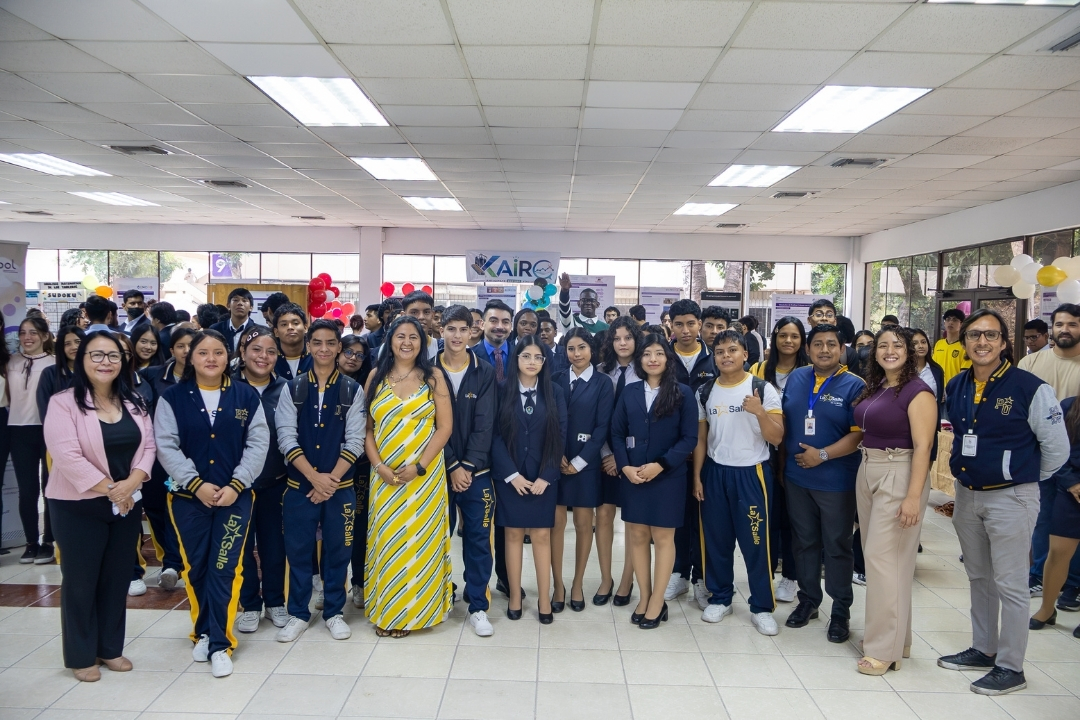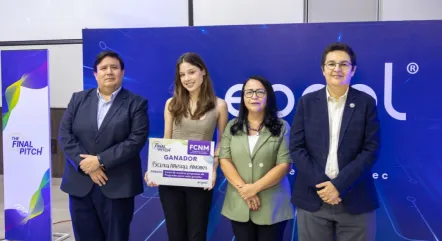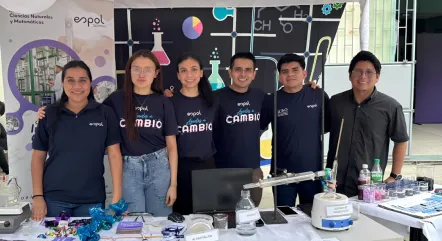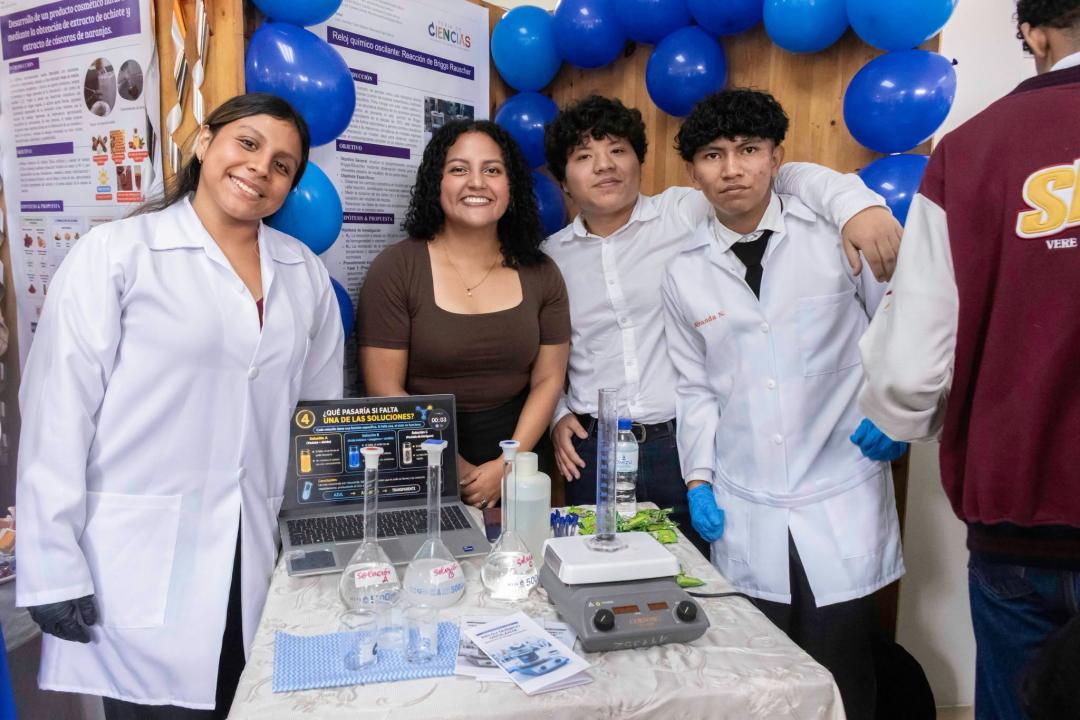


Over 400 11th and 12th graders from seven Guayaquil schools gathered at ESPOL’s Faculty of Natural Sciences and Mathematics (FCNM) for a day packed with science, experimentation, and hands-on discovery.
Organized by the FCNM, the Science Fair took place on Friday, August 14, in Building 9D of the faculty, showcasing 34 projects across Mathematics, Physics, Chemistry, Logistics, and Statistics.
Beyond project displays, the event offered a platform to bring science closer to the next generation. Bringing together over 400 high schoolers gave students from various schools a firsthand look at scientific work and allowed them to explore, through interactive experiences, the possibilities offered by different fields of study. Ultimately, the initiative helps spark their curiosity while demonstrating that science can be a powerful path to learning, creating, and shaping the world around them.
During the opening ceremony, Vice President of Academic Affairs Paola Romero, Ph.D., welcomed the students and emphasized the vital role learning plays in building their future. Meanwhile, FCNM Associate Dean María Nela Pastuizaca Fernández, Ph.D., highlighted curiosity as an essential driver for scientific growth and discovery.
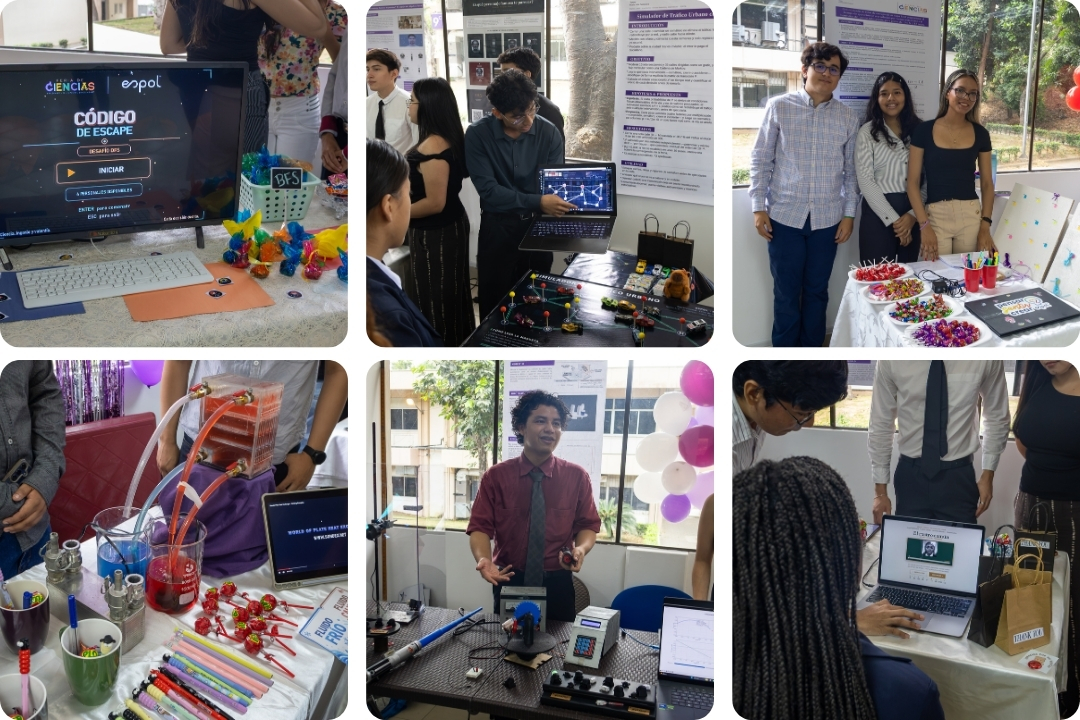
From Ideas to Hands-On Experimentation
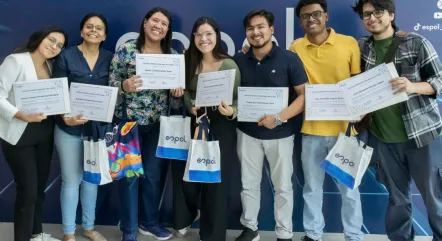
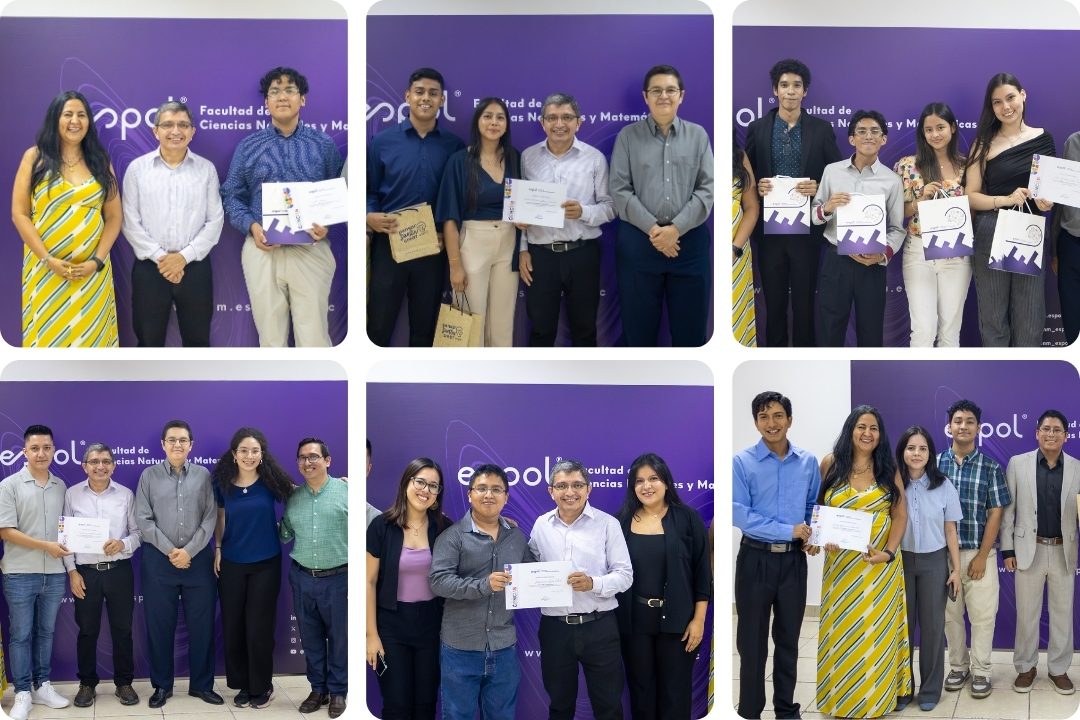
The presented projects allowed students to translate classroom knowledge into concrete research, experimentation, real-world application, and science communication. The fair also aimed to foster curiosity, critical thinking, creativity, collaborative teamwork, and the ability to explain complex concepts in an accessible way. At the end of the event, top projects were recognized in two categories: Experiment and Demonstration.
In the Experiment category—which features projects where students design experimental procedures to analyze phenomena, gather data, and back up conclusions—the winners were:
1st Place: Graph and Maze Searches (Mathematics), developed by Karen Tatiana Trujillo Calle, Britta Sophie Wozniak Villagómez, Matías Ariel Sánchez Baldeón, and Santiago Rubén Gómez Medina.
2nd Place: Plate Heat Exchanger (Chemistry), developed by Juan Carlos Chalen Ramírez, Javier Ismael Pichucho Chérrez, Elvis Nelson Viteri Peñafiel, Teófilo Antonie Rodas Avilés, Brigitte Dayanara Bravo Menéndez, and Camila Alejandra Paredes Ruiz.
3rd Place: Organic Chemistry as a Tool in Chemical Engineering G2 (Chemistry), developed by Ariel Pierre Suquinagua Carrera, Elkin Anderson Alvarado Pérez, and Christian Andrés Martínez Balcázar.
In the Demonstration category—focused on projects that clearly explain, demonstrate, or apply a scientific or mathematical principle—the winners were:
1st Place: Matching (Graph Matching), (Mathematics), developed by Doylet Millan Segundo Gabriel.
2nd Place: Statistical Surveillance and Loss Prevention System for Industrial Production using Digital Twin and Local AI Assistant (Mathematics), developed by Iker Xavier Moran Villavicencio and Natasha Roxana Anzules Rivera.
3rd Place: Wastewater Treatment via Coagulation-Flocculation (Chemistry), developed by Romina Hervas.
Science as a Starting Point
During the closing ceremony, Vice President for Research, Development, and Innovation Carlos Monsalve, Ph.D., highlighted the pivotal role of science in understanding how the universe works and answering the questions driven by our curiosity.
For Professor Gabriel Barreto, a member of the organizing team, the Science Fair represents far more than just a final showcase of projects. It is an opportunity for students to take an active role in their learning, pitch and defend their ideas before faculty and judges, and discover how knowledge can be applied to interpret and solve real-world problems.
From this perspective, the fair also served as a stage to highlight student talent, bridge different fields of study, and foster an academic culture built on initiative, rigor, and excellence. The combined effort of students, professors, mentors, judges, and staff made the event a true hub for scientific discovery and learning.
Ultimately, the FCNM Science Fair demonstrated that hands-on experimentation is a powerful way to learn—by asking questions, testing ideas, presenting results, and unlocking new possibilities. It was an inspiring showcase of youth potential, reminding us that by empowering young talent, we build the future through science.