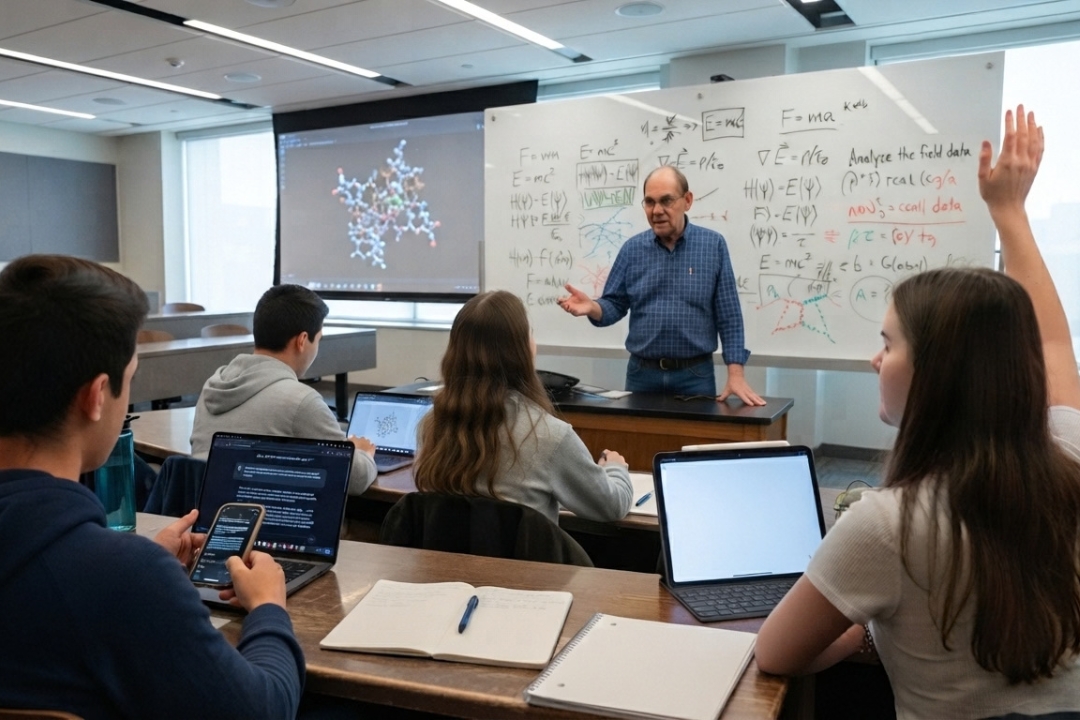


Typically, learning about motion and velocity in science classes has been limited to memorizing formulas and performing calculations by rote. However, a recent study published in the prestigious international journal Physical Review Physics Education Research demonstrates that combining artificial intelligence (AI) with the classic method of questioning and reflection (the Socratic method) can completely transform how future teachers learn to reason and understand physics.
The study was jointly conducted by researchers from Universidad Estatal de Milagro (UNEMI) and the Department of Physics at ESPOL’s Faculty of Natural Sciences and Mathematics (FCNM), featuring Dr. Erick Lamilla Rubio as part of the research team.
Traditionally, learning one-dimensional kinematics—the study of motion in a straight line—has focused on executing mechanical procedures. To break away from this approach, the research team implemented the SOCRATIC-AI learning model. The study was carried out with 18 university students (future Physics educators) organized into small working groups.
During the activities, students solved physics problems in two stages: first, through a guided Q&A dialogue led solely by the professor; and second, using AI as a support tool under faculty supervision, with explicit guidelines on how to prompt the tool.
The results were clear: when students used AI as a supporting tool, they achieved significantly higher scores in key areas such as critical thinking, physics comprehension, argumentation, and error correction. Additionally, surveys showed that prospective teachers felt more motivated and confident in their abilities.
However, researchers issue an important caution: using technology also requires greater attention and mental effort, as students must carefully verify that the information is accurate and avoid becoming dependent on the tool.
Although the data must be interpreted carefully given the students' prior knowledge, the study demonstrates that artificial intelligence—when used effectively to guide learning rather than as a shortcut to do all the work—is a powerful tool for stimulating deep thinking and autonomy.
Research like this reaffirms the commitment of ESPOL’s Faculty of Natural Sciences and Mathematics (FCNM) to educational innovation and high-level research. By rigorously exploring the intersection between emerging technologies and exact sciences education, the institution drives cutting-edge pedagogical solutions that strengthen teacher training and promote a more reflective, analytical scientific education focused on critical future competencies. As Dr. Erick Lamilla Rubio summarizes: “AI can transform physics education when used to guide reasoning, not replace it.