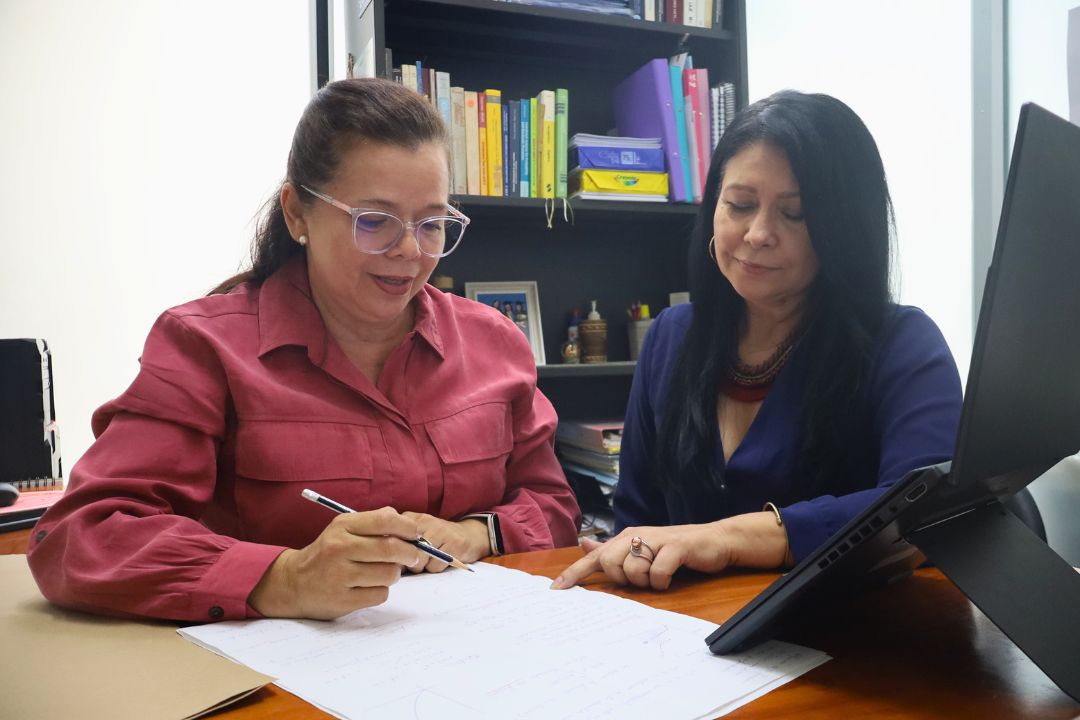


Dr. Mireya Bracamonte and Dr. Liliana Pérez, faculty members at ESPOL’s Faculty of Natural Sciences and Mathematics (FCNM), have published a new scientific study in AIMS Mathematics, an international Q1-ranked journal, placing it among the highest-impact academic publications in its field.
The study, titled “Solutions to Volterra Integral Equations in Bounded Φ-Variation Spaces,” generalizes a mathematical problem related to Volterra integral equations, which are used to model phenomena whose evolution depends on past events, commonly referred to as memory-dependent systems.
These models are important because they allow researchers to represent processes in which past states directly influence future behavior. Examples can be found in fields such as physics, engineering, economics, and dynamical systems.
The objective of the study was to establish the conditions required to guarantee the existence of solutions to this type of equation when working with functions belonging to a generalized variation framework, rather than the continuous functions traditionally used in these problems.
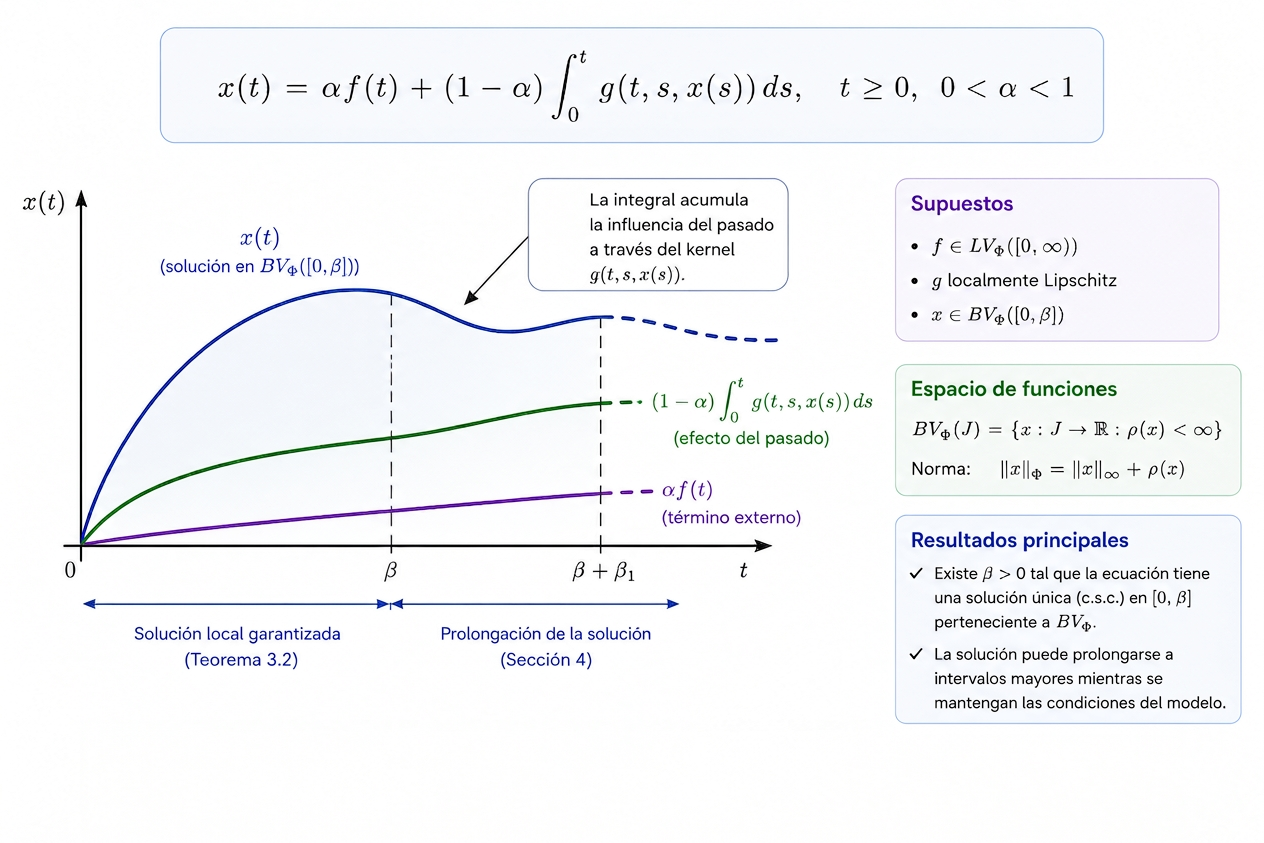
To achieve this, the researchers employed mathematical models from functional analysis. Among the techniques used, the method of successive approximations played a central role, allowing them to establish the convergence and stability of the solutions obtained.
One of the study’s most significant findings was the formal proof that these equations admit unique solutions, except on sets of measure zero, within spaces of bounded Φ-variation. The researchers also demonstrated that these solutions can be consistently extended to larger time intervals.
According to the authors, this work strengthens the theory of integral equations and broadens the mathematical foundations required for future research in both theoretical functional analysis and applied mathematics.
As a next step, the research team will continue exploring new structural properties of these solutions and their behavior under more general integral operators, further contributing to the advancement of mathematical knowledge within increasingly broad functional frameworks.
The full publication is available at: AIMS Mathematics