

Behind every business decision lies information that must be analyzed and transformed into meaningful insights. This has been one of the most important lessons learned by Brigitte Maribel Andrade Márquez, a seventh-semester Statistics Engineering student at ESPOL’s Faculty of Natural Sciences and Mathematics (FCNM), during her internship at DEPRATI.
Recognized as one of Ecuador’s leading department store chains, DEPRATI manages large volumes of information related to sales, inventory, and product performance on a daily basis. Within this environment, Brigitte works in the Women’s Apparel Division, specifically in the Purchasing Department, where she serves as a Commercial Demand Planning Intern and participates in processes related to sales monitoring, inventory management, and commercial planning.
Her responsibilities include updating daily sales reports, monitoring merchandise arrivals, tracking product orders and transfers between stores, and analyzing Open-to-Buy (OTB) metrics, a tool used to plan and control the budget allocated for future purchases.
Through these activities, she has gained firsthand experience in understanding how data analysis supports decision-making in the retail industry.
“I have found it fascinating to learn about the dynamics of the retail sector, where it is essential to continuously monitor sales, inventory levels, and product distribution in order to respond efficiently to customer needs,” she says.
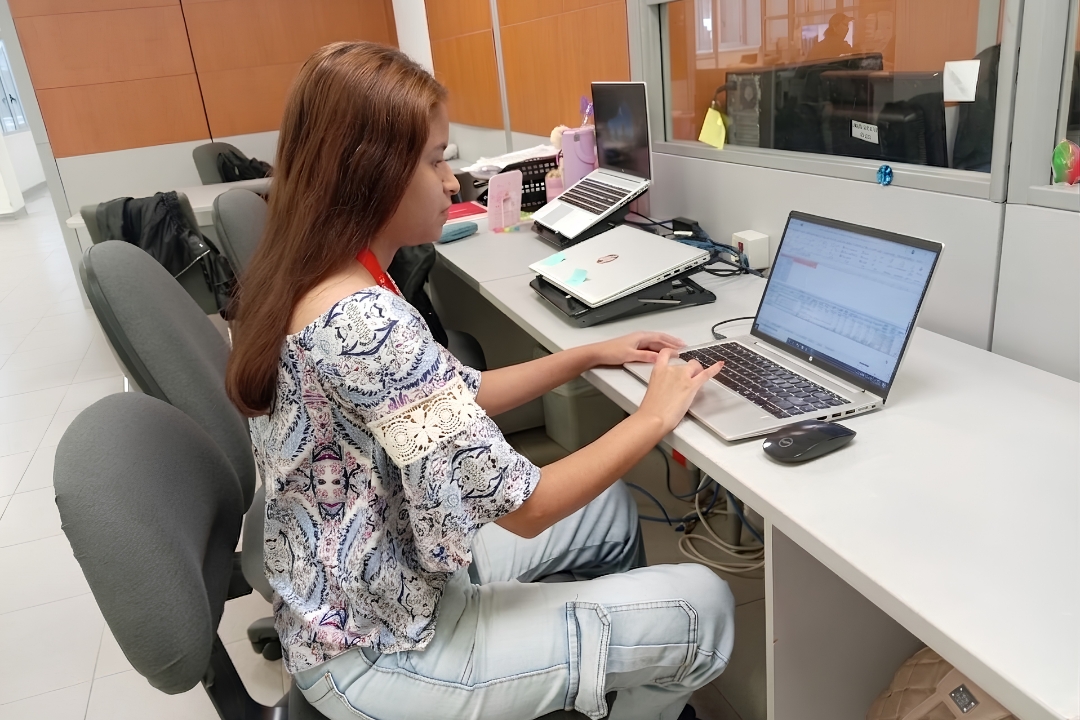
Throughout her internship, Brigitte has applied the knowledge acquired in her degree program using tools such as Excel, RStudio, and SQL to process data, generate reports, and monitor key business performance indicators. She notes that courses such as Data Engineering, Statistics I, and Time Series Analysis were instrumental in helping her transform data into strategic insights that support the analysis and understanding of sales trends over time.
One of the lessons she values most is learning how to turn data into meaningful information for decision-making. She also highlights the importance of teamwork, cross-functional communication, and the responsibility that comes with managing information that directly impacts business operations.
“It has been an enriching experience that has allowed me to apply my academic knowledge in a real-world setting and better understand the role data plays in business decision-making,” she says.
Experiences like Brigitte’s reflect the commitment of ESPOL’s Faculty of Natural Sciences and Mathematics to providing an education that combines statistical expertise, technological skills, and strong connections with industry. Through internships and partnerships with the business sector, students strengthen their professional competencies and apply classroom knowledge to develop solutions that create value for organizations and support data-driven decision-making.
Learn more about the Statistics Engineering program:
https://www.fcnm.espol.edu.ec/en/undergraduate-programs/statistics