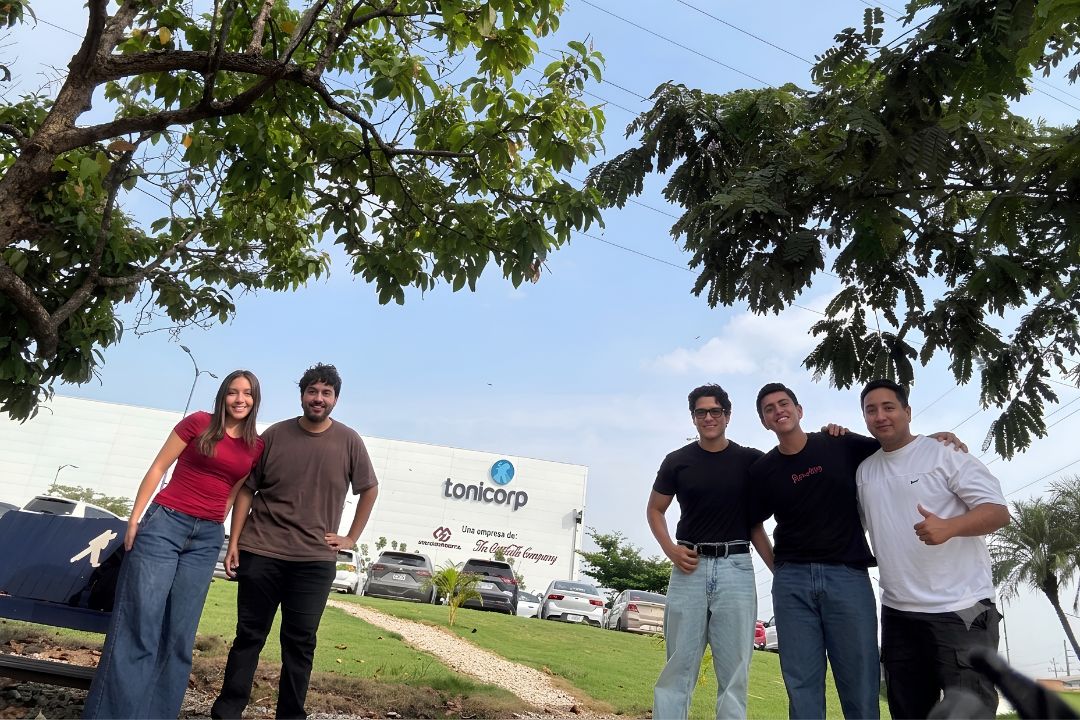


What began as knowledge acquired in the classroom soon became operational decisions, data analysis, and process improvement initiatives within a high-demand operation. For Paúl Alberto Segarra Varas, an eighth-semester Logistics and Transportation Engineering student at ESPOL’s Faculty of Natural Sciences and Mathematics, his internship in the Logistics Projects area of Tonicorp’s Raw Materials Warehouse in Guayaquil provided the opportunity to transform theory into solutions for real-world industry challenges.
From the beginning of his internship, Paúl became involved in strategic processes related to warehouse management, inventory control, and operational optimization. His work focused on data collection, analysis, and the development of solutions aimed at improving logistics efficiency in real operational environments.
One of the projects that defined his experience was the implementation of a digital warehouse layout system using QR codes for the dynamic assignment of pallet locations. This initiative helped optimize picking and dispatch times by improving the identification and tracking of raw materials within the warehouse.
“Seeing the operations team use the new digitalized layout and noticing the reduction in raw material search times was the clearest confirmation of the impact of my work,” he said.
His experience also involved operational waste analysis, inventory valuation, and the development of decision-support tools. To accomplish this, he applied knowledge gained throughout his university education, using tools such as Power BI, Power Query, Excel, and VBA programming to automate processes and build operational performance dashboards.
Beyond the technical tools, Paúl emphasizes that his degree program provided him with a structured approach to solving complex problems.
“The university taught me not to look for superficial solutions, but rather to model problems, analyze constraints, and propose improvements based on real data,” he explained.
Among the courses he considers most valuable in preparing him for this professional challenge are Warehouse Systems, Production Logistics, Operations Research, and Supply Chain Database Management.
However, one of the most important lessons came from outside the models and algorithms. Through his work with operational teams, he learned that even the best technical solutions only succeed when people are part of the change process.
“Logistics looks perfect on paper, but in practice it depends on the human factor and the ability to adapt. A great technical design only succeeds when it is developed alongside the operational team,” he noted.
Now, having completed this stage of his professional development, Paúl describes the experience as an opportunity to transform theory into tangible results.
“It was an invaluable opportunity to turn mathematical and logistics knowledge into efficient solutions for real-world industry challenges,” he said.
Paúl’s story is a strong example of what it means to study Logistics and Transportation Engineering: tackling real-world problems, working with data, technology, and operations, and seeing how that work creates impact beyond the classroom.
At ESPOL’s Faculty of Natural Sciences and Mathematics, the program is designed so that students not only learn theory but also understand how to apply it. The curriculum combines a strong technical foundation with analytical thinking, problem-solving skills, and direct engagement with industry through internships, real-world projects, and partnerships with the productive sector, ensuring that graduates are prepared to contribute from day one.
Interested in leading supply chain, operations, or transportation processes? Learn more about the Logistics and Transportation Engineering program at: https://www.fcnm.espol.edu.ec/en/undergraduate-programs/logistics-and-transportation