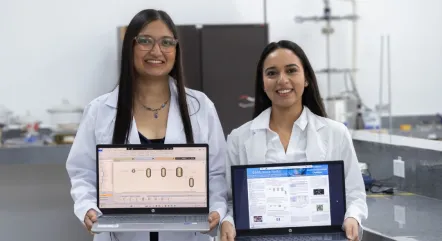


How can the accuracy of data analysis be improved when some observations are partially or completely missing because they fall outside detection limits? This question was at the heart of the doctoral dissertation of Dr. Katherine Loor, a faculty member of the Faculty of Natural Sciences and Mathematics (FCNM), whose work was recognized among the three best dissertations at the 69th Annual Meeting of the Brazilian Region of the International Biometric Society (RBras) and the 21st Symposium on Applied Statistics in Agronomic Experimentation (SEAGRO), organized by the Federal University of Espírito Santo (UFES).
Her research focuses on the development and application of statistical models for censored data, a common challenge in fields such as medicine, environmental monitoring, biology, and agronomy. “Censoring occurs, for example, when measurement instruments fail to detect values below or above certain thresholds, limiting the effectiveness of traditional analytical methods,” explained Dr. Loor.
Unlike conventional models that rely on the normal distribution, Dr. Loor proposes the use of Student’s t and skew-t distributions (which account for heavy tails and asymmetry), allowing for more robust handling of outliers and departures from normality.
The journey was not without challenges. “The difficulty was not only computational, in terms of algorithm implementation, but also methodological. On several occasions, the simulated scenarios did not adequately represent real-world situations, forcing me to completely rethink the approach. Each new simulation took days to run while the clock kept ticking,” she recalled.
The effort, however, paid off. Her dissertation was selected among the top three out of twelve submissions.
“That recognition represented a validation of the effort I dedicated over many years: the long hours of studying, programming, endless revisions, moments of doubt, creative blocks… all of that, not to mention the many personal challenges I faced along the way. Receiving this award gave me confidence that my contribution has value within the statistical community and renewed my motivation to continue conducting research,” she stated.
The award recognizes the quality, originality, and scientific relevance of the submitted work. The evaluation was conducted under rigorous criteria that included theoretical and methodological soundness, the applicability of the proposed approach, and its contribution to advancing applied statistics.
Dr. Loor also expressed her gratitude to her thesis advisors, her husband, her colleagues, and everyone who supported her throughout the process.
The contributions of this research open new possibilities for improving analyses across multiple fields. In environmental studies, the developed models enable more accurate estimates of air and water pollution levels, even when the true values are unobservable or fall outside the detection limits of measurement instruments.
In medicine, these approaches can be applied to the analysis of biomarkers, clinical diagnoses, and epidemiological studies involving partially observed data. Furthermore, the code implementing the proposed methods has been developed in the R programming language and is freely available to the academic community through the official CRAN (Comprehensive R Archive Network) repository.
Finally, she shared a message for young researchers:
“My main advice for those beginning their research journey, regardless of their field, is to cultivate both rigor and curiosity: study the theory in depth, but never lose sight of real-world applications. Do not be afraid to tackle difficult problems or explore unconventional approaches, because that is often where the most valuable contributions emerge.”
At FCNM, we proudly celebrate this achievement, which reflects the academic excellence of our faculty and their commitment to impactful scientific research.